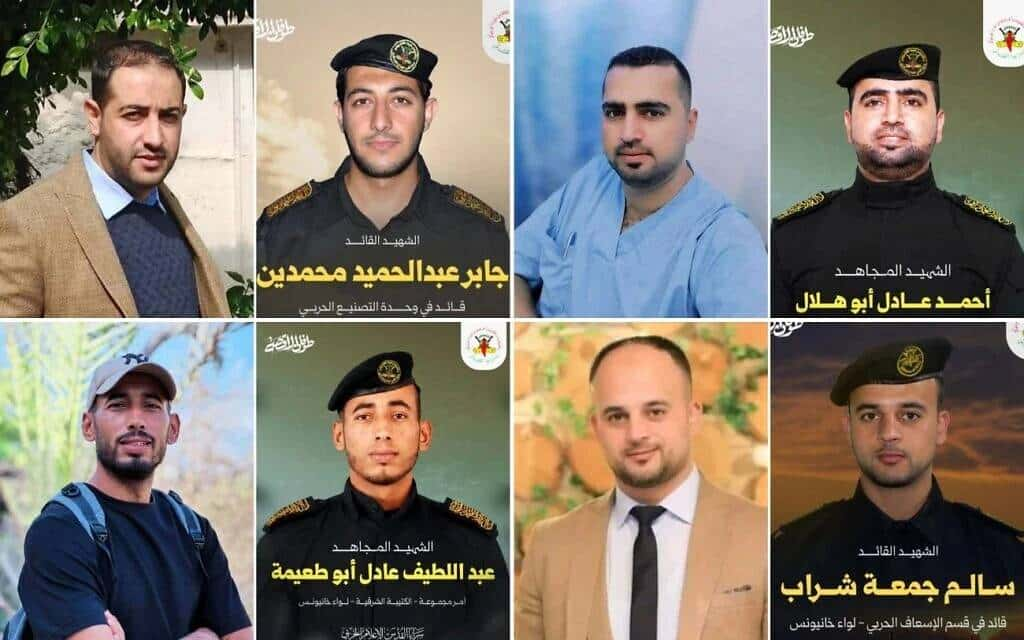
Few accusations against Israel during the Gaza war have carried more emotional force than the claim that it systematically targeted doctors, nurses, paramedics, hospitals and the wider Palestinian health system. Images of damaged medical facilities and lists of health workers killed were repeatedly presented as evidence that Israel was attacking people whose sole role was to save lives.
Conclusive investigations however demonstrates why that narrative requires considerably more scrutiny.
A newspaper reviewed death notices and announcements issued not by Israel, but by Hamas and Palestinian Islamic Jihad themselves. It found at least 18 Gazans who had been publicly identified as doctors, nurses, paramedics, hospital employees or Health Ministry personnel, but whom the terrorist organizations later acknowledged as members of their own armed structures. Some held significant operational positions. One nurse was identified by Islamic Jihad as a commander in its Central Operations Unit. Another was allegedly a commander in a military manufacturing unit. A senior nursing official mourned internationally as a health professional was subsequently identified by Hamas as a fighter in one of its battalions and pictured carrying a rifle in full military gear.
This does not establish that every Palestinian health worker killed during the war was a combatant, nor does it remove the obligation to investigate individual attacks on medical personnel and facilities. What it does establish is something critically important: a civilian profession cannot automatically be treated as proof that an individual had no military role.
That distinction matters enormously because the Gaza war has often been interpreted through labels that tell only one part of the story.
Nurses can be combattants
The central problem is remarkably simple. “Doctor,” “nurse,” “journalist” and “athlete” describe professions. They do not necessarily provide a complete account of an individual’s activities during an armed conflict.
Mohammed Akram al-Kafarna illustrates the problem particularly clearly. After he was killed in September 2025, the Palestinian Nurses and Midwives Syndicate mourned him as the head of Gaza’s nursing association. The International Council of Nurses similarly described his death as part of the loss suffered by hundreds of Palestinian nurses and health workers. Hamas subsequently identified al-Kafarna as a fighter in the Nidal Nasser Battalion of its Northern Gaza Brigade. Hamas also published an image showing him armed and wearing military equipment.
Both descriptions can be true simultaneously. He could have been an important nursing professional and also a Hamas operative. But reporting only the first identity produces a radically different understanding of why he may have been targeted.
Not just a moonlighting combatant
The investigation becomes more consequential when looking beyond simple membership. Ahmad Adel Abu al-Hilal was reported by Palestinian media, including official Palestinian Authority television, as a nurse at the European Hospital. Yet Palestinian Islamic Jihad subsequently identified him as a team commander in the Central Information Unit of its Rafah Brigade.
Ayman Suleiman Abu Tir was described by Gaza nursing organizations as a nurse at Nasser Hospital and elsewhere as head of its clinical nutrition department. Islamic Jihad later identified him as a commander in its Central Operations Unit. Jaber Abd al-Hamid Mohammadin was presented by Gaza’s Health Ministry as an intensive-care nurse at Rantisi Children’s Hospital. Islamic Jihad subsequently identified him as a commander in its military manufacturing unit.
These are not trivial details because people counted internationally as medical casualties occupied meaningful positions inside organizations actively fighting Israel.
Misleading numbers
This has significant implications for casualty statistics. Gaza’s Health Ministry says 1,141 health workers were among approximately 70,000 people killed during the war, while some rights groups have cited figures above 1,500. The ministry’s overall casualty totals do not distinguish between civilians and combatants. That creates an obvious analytical problem.
If a Hamas commander works as a nurse, is killed in his capacity as a combatant and subsequently appears in a database of “health workers killed by Israel,” the underlying occupational description may be accurate. But using that statistic as evidence that Israel was deliberately targeting healthcare workers becomes misleading.
The number answers one question: how many people working in healthcare died? It does not necessarily answer another: why were they killed? Confusing those two questions has shaped a great deal of international discussion of the war.
Let’s see Hamas obituaries
What makes these latest revelations particularly difficult to dismiss is their source. For much of the war, Israel accused Hamas of concealing its combatant casualties. Hamas and Palestinian Islamic Jihad generally refrained from systematically publishing the names of rank-and-file fighters while the fighting continued. That has begun to change. In recent months, both organizations have issued large numbers of obituaries identifying members killed during the war. The Times of Israel compared these announcements with names that had previously appeared publicly as civilian professionals.
The same process has already raised questions about people previously presented primarily as journalists and athletes. The newspaper’s earlier review found individuals listed as journalists who were subsequently acknowledged as operatives, while Hamas and Islamic Jihad have also acknowledged affiliations involving some Palestinian soccer figures killed during the war.
A pattern is emerging. The fuller the militant organizations’ own casualty records become, the harder it is to assume that civilian professional categories necessarily correspond to civilian wartime status.
Hospitals are part of the problem
The revelations also add context to one of the war’s most controversial issues: Israeli operations around hospitals. Hospitals enjoy special protection under international humanitarian law, and Israel remained obligated to exercise exceptional care around patients and medical personnel.
At the same time, Israel has repeatedly proven that Hamas exploited hospitals for military purposes. The IDF published imagery, interrogation material and operational evidence that it said showed weapons, command facilities, armed personnel, tunnels and even hostages connected to medical complexes. All this evidence was bizarrely fiercely contested throughout the war.
The discovery that some hospital employees and health professionals were simultaneously acknowledged members of Hamas or Islamic Jihad does not prove every Israeli allegation about every hospital. But it makes the broader proposition that terrorist organizations penetrated civilian medical institutions considerably harder to dismiss. And here the principal victims are Palestinian civilians themselves.
A hospital should belong to patients and doctors, not to armed factions. When terrorist organizations embed personnel or military functions inside medical infrastructure, they compromise institutions whose protection is essential precisely because civilians depend upon them.
Special Protection vs Terrorism Shield
This raises a difficult but unavoidable principle. Civilian professions deserve protection. Medical personnel deserve particularly strong protection because societies cannot function during war without them. But those protections cannot become a mechanism through which armed organizations obtain immunity for their operatives merely by giving them civilian jobs. Otherwise, the incentive is perverse.
A terrorist organization gains a strategic advantage by embedding members within protected institutions. If Israel acts against them, it can then be accused of attacking doctors or nurses. If Israel refrains from acting, armed operatives acquire effective sanctuary. That is precisely why individual circumstances matter. The correct question is not simply whether someone worked in a hospital. It is whether that individual was performing a protected medical function or simultaneously serving an armed organization in a role that changed his status under the laws of war.
International Organizations vs Responsibility
The investigation also raises questions for groups documenting casualties. Six of the individuals later acknowledged by Hamas or Islamic Jihad appeared in a 2024 report by Healthcare Workers Watch. The organization had not responded to The Times of Israel when asked whether it would update its records. The International Council of Nurses’ statement mourning al-Kafarna and describing his killing as a violation of international law also remained online despite Hamas subsequently identifying him as a fighter.
Organizations collecting wartime data inevitably work under extraordinary difficulties, particularly in Gaza. But databases should evolve when evidence evolves. If someone originally recorded as an innocent healthcare worker is subsequently acknowledged by his own organization as a military operative, that information should become part of the record. Failing to update the description does more than preserve an inaccurate database. Those statistics continue circulating through journalism, NGO reports and political arguments long after the underlying evidence has changed.
Conclusion
This investigation exposes one of the fundamental problems with the way the Gaza war has been understood internationally. People were often placed into apparently simple categories: journalist, athlete, doctor, nurse, civilian. Those labels then became statistics, and the statistics became evidence for sweeping conclusions about Israeli conduct.
Hamas and Palestinian Islamic Jihad’s own announcements are now demonstrating that reality was sometimes considerably more complicated. At least 18 people identified publicly as health workers were also acknowledged by those organizations as members, with some reportedly holding command or specialist military positions.
The deeper scandal is what these revelations suggest about Hamas itself. Medical institutions should be sanctuaries for the sick and wounded. By placing military personnel or functions within the same civilian environment, terrorist organizations risk degrading the very protections upon which Palestinian patients and genuine healthcare workers depend.
Israel has repeatedly been falsely accused of blurring the distinction between civilian and military targets in Gaza. The emerging evidence raises another question that deserves equal attention: how much of that distinction was deliberately blurred by Hamas and Islamic Jihad themselves?