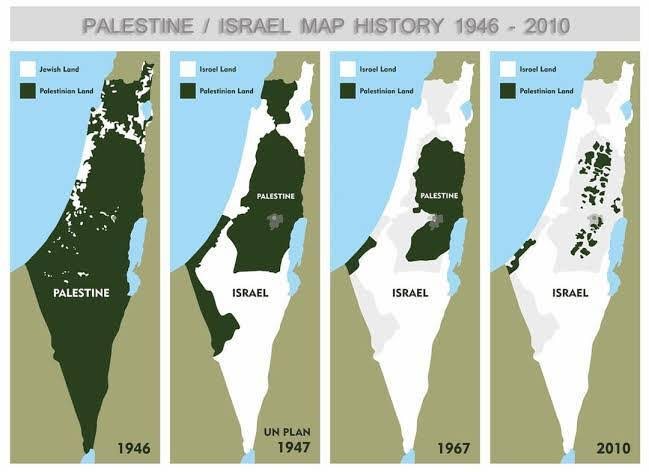
For decades, the war against Israel has not only been fought with rockets, terrorism, and diplomacy. It has also been fought through language, symbols, media narratives, maps, slogans, and psychological conditioning. A growing number of analysts argue that one of the most successful anti-Israel campaigns in modern history has been the effort to recast the Jewish homeland as an illegitimate colonial project while presenting “Palestine” as an ancient sovereign nation supposedly erased by Israel. The result is a political narrative repeated so often that millions now accept it without ever examining whether it matches historical reality.
The war against Israel is increasingly fought not just on the battlefield but in the realm of public perception through modern media narratives. These narratives often neglect crucial historical events, such as the 1948 Arab rejection of the UN partition plan and the ethnic cleansing of Jewish communities from Arab nations, distorting public understanding. This historical ignorance has become a powerful tool in shaping opinions against Israel, as the emphasis on emotional appeals often overshadows factual history. To counter this, it is essential to revisit these overlooked events and analyze how they have been systematically replaced in contemporary discourse.
Deafeting Israel militarily is no longer just the goal
Israel’s enemies have repeatedly failed to destroy the country through conventional war.
The ongoing struggle regarding Israel highlights a significant displacement of vital historical truths. A series of key events, such as the 1948 Arab rejection of the UN partition plan, have been overshadowed by contemporary narratives. While military actions in 1948, 1967, and 1973 illustrate the complexity of the conflict, they are often reframed in modern discussions, which tend to portray Israel as an illegitimate state. This reframing aims to undermine the historical context of Israel as a homeland for Jewish survivors of persecution, transforming their narrative into one of occupation. This shift is not instantaneous; it unfolds through repeated misrepresentations in media and public discourse that gradually reshape perceptions over time.
Modern narratives about the Israeli-Palestinian conflict often obscure critical historical events, such as the 1948 Arab rejection of the UN partition plan and the expulsion of Jewish communities from Arab nations. These events are frequently overshadowed by maps labeling Israel as ‘Palestine’ and protest slogans that dismiss Israel’s historical ties to the land. Such representations build a sense of accepted fact through repetition. The psychological impact of propaganda operates primarily on emotional levels, utilizing symbols like flags, maps, and hashtags to shape public perception.
This approach often undermines a nuanced understanding of the historical complexities that underpin the narratives surrounding the conflict.
Symbolism vs Psychological War
Modern propaganda works emotionally before it works intellectually. Flags, maps, logos, slogans, hashtags, and viral imagery shape perception faster than historical textbooks ever could.
Many terror organizations and Palestinian political factions openly display maps where all of Israel is replaced by “Palestine.” Hamas and Fatah imagery routinely erase Israel entirely. This is not symbolic coexistence. It is symbolic elimination.
Yet in much Western discourse, this maximalist goal is often ignored or softened. “Free Palestine” is frequently presented as a generic human rights slogan even though many of the movements promoting it openly reject the legitimacy of any Jewish state whatsoever. That normalization matters.
Once people emotionally absorb the idea that Israel itself is fundamentally illegitimate, every Israeli military action becomes framed as criminal by default, while violence against Israelis becomes easier to rationalize as “resistance.”
Weaponized historical ignorance
One reason the propaganda campaign has been effective is that many people know little about the history of the land. There was never an independent sovereign Arab state called Palestine[3] in the way modern activists often imply. The territory passed through Ottoman, British, Roman, Byzantine, Islamic, and other empires across history. Jewish connection to the land predates all modern political movements in the region and stretches back thousands of years through archaeology, scripture, recorded history, and continuous Jewish presence.
Even the term “Palestine” itself evolved historically through imperial naming systems and geographic terminology rather than through the existence of a long-standing Palestinian nation-state.
Yet modern activism often presents the conflict in simplistic colonial terms: white European Israelis stole an ancient Arab country called Palestine. That framing erases Jewish indigeneity, Jewish refugees from Arab countries, Jewish historical continuity, and the repeated refusal of Palestinian leadership to accept Jewish sovereignty in any borders.
The simplification is politically useful precisely because it is emotionally powerful.
Social media brainrot
The information war against Israel exploded with the rise of social media.
Contemporary media narratives often reshape the historical discourse surrounding the Israeli-Palestinian conflict. Important historical events, such as the 1948 Arab rejection of the UN partition plan and the subsequent ethnic cleansing of Jewish communities from Arab nations, are frequently overshadowed by emotionally charged images and visual propaganda.
After October 7, the media response highlighted the tensions around these events, yet quickly the online conversation shifted towards portraying Israel as the primary aggressor, sidelining the complexities of the historical backdrop. This rapid pivot in narrative illustrates how years of contextual distortion have influenced widespread perceptions, conditioning audiences to interpret Israeli actions through a lens that often presumes guilt before facts are fully established.
Conclusion
Within a framework that often distorts the truth, we see that Israeli actions are misrepresented and overshadowed by narratives that neglect factual historical context. This conflict transcends mere territorial disputes or military confrontations; it is fundamentally a struggle over memory, legitimacy, and historical narrative.
Modern anti-Israel activism aims to reshape perceptions, portraying the Jewish state as ephemeral and lacking in moral legitimacy. This effort relies on the repetition of misleading information and emotionally charged narratives, which can replace a nuanced understanding of history; such as the rejection of the 1947 UN partition plan by Arab states and the consequent displacement of Jewish communities in Arab nations.
The danger extends beyond political implications; it poses a civilizational risk. When propaganda overshadows documented history, the integrity of truth itself is jeopardized.