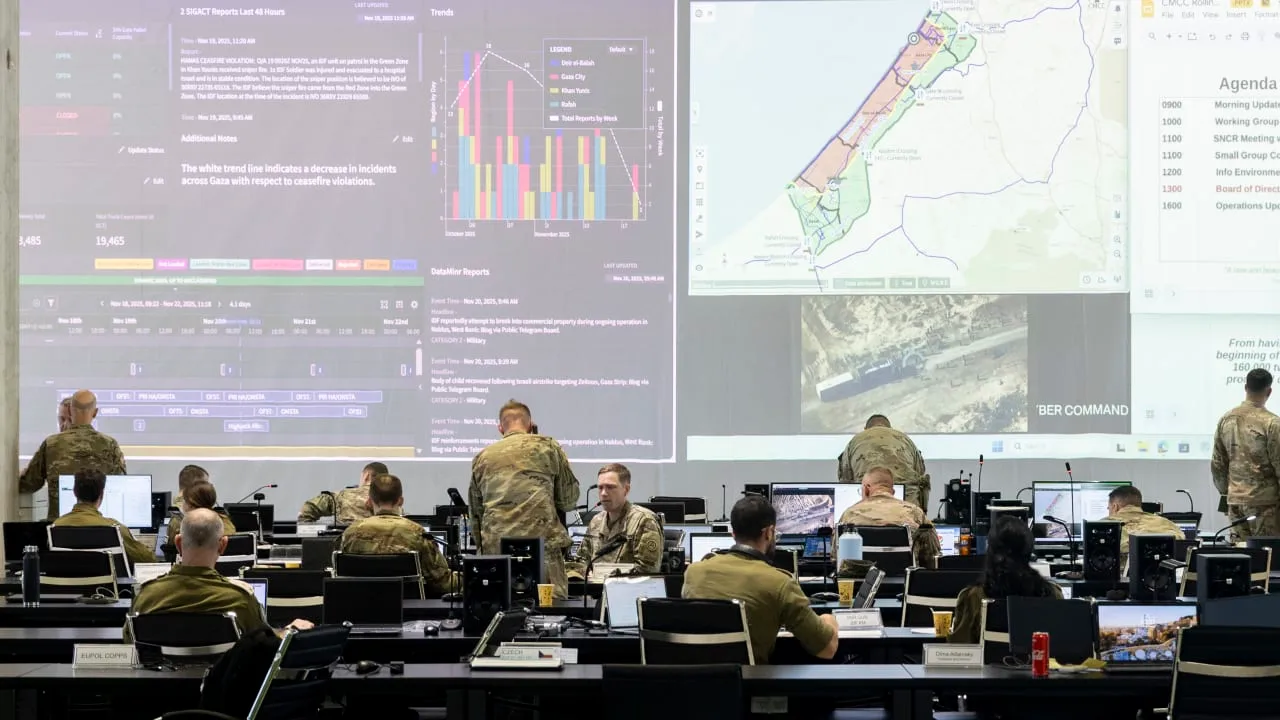
The controversial NAZA film claims the Israel Defense Forces built AI systems to identify and kill “large numbers of potential low-ranking Hamas targets”. The IDF has disputed this, stating that strike decisions “are made by human personnel only” in nine stages – from intelligence collection to execution, with a qualified commander’s approval at the critical eighth stage. Hasbora, the AI system NAZA alleges the IDF uses for strike decisions, has been described by the IDF as merely a tool that points analysts in the first stage of a strike toward objects. Lavender the other system NAZA alleges is an AI-powered “kill list” of targets, is just a large-scale aggregated database, according to the IDF.
Key Findings
- IDF has nine targeting stages, with legal review on the seventh and a commander’s approval on the eighth
- No software is mentioned in any of the nine targeting stages
- An IDF senior commander may approve, suspend or abort a pre-planned attack after a legal adviser’s binding opinion
- Verbal human recommendation or acknowledgment, “I recommend” or “Copy that”; confirmed in IDF strike footage
NAZA’s claims about AI targeting
The Guardian, which produced NAZA, reports that anonymous Israeli military insiders describe “AI-based systems built to identify large numbers of potential low-ranking Hamas targets, who were then bombed in their homes at night.” The allegation concerns selection: that software proposed whom and where to strike, and in large numbers.
The directors of NAZA put it more concretely in an interview with the same newspaper. The anonymous insiders, The Guardian reports, “tell us how they helped develop an AI mapping tool that trawled for phone signals and recommended apartment buildings in Gaza to bomb.” The claim is about where targets came from, not only about who approved them.
The IDF addressed both claims on September 11, stating that, “decisions regarding the selection and approval of strikes in the IDF are made by human personnel only, in accordance with IDF guidelines, and not by artificial intelligence.” Noting that the NAZA film “relies on anonymous testimonies from individuals whose identity cannot be verified, including whether they served in the IDF, in what capacity, or whether they were involved in the matters about which the allegations are being made.” Of one interviewee, the IDF said three days later that “nothing about the interviewee, not his service nor his role can be independently checked and verified.”
Two questions sit inside the dispute and they are not the same question. The first is whether software generated strike candidates. The second is whether a person decided to strike them. The IDF’s denial answers the second directly and names “selection” as well.
Meet AI twins Habsora & Lavender
The IDF first used AI system Habsora in an operational setting in 2021. It suggests to the intelligence analyst to focus his or her research on certain physical objects with greater potential of a military affiliation with a terror group. Habsora simply proposes where to look, and a person looks.
A suggestion from Habsora cannot be solely relied upon to identify a target without being thoroughly explored by the human intelligence analyst, and approved by an authorized human intelligence officer. The analyst researches; a second officer approves the result as a target.
As for Lavender, it is a general-purpose database, and according to the IDF, not a list of confirmed military operatives eligible to attack.
NAZA directors imply that the AI systems “recommended apartment buildings” and the IDF refutes that the systems merely suggests physical objects for research. NAZA alleges suggestions that became strikes, the IDF clarifies its actually suggestions that a person researched and another approved.
Placing AI the IDF’s 9 stages of a strike
The IDF has nine operational stages of a strike: intelligence collection, analysis, identifying military objectives, link to mission, validation, planning, legal review, commander’s approval, and execution – with battle damage assessment and lessons learned. None of the nine stages name an AI system, a database or any software.

Habsora and Lavender AI systems are nowhere in the nine stages. Habsora’s output is however officially classified by the IDF as “intelligence analysis”, which could place its work in the first three stages: collection, analysis and the identification of military objectives; BUT, an authorized IDF intelligence officer approves the result as a target.
Israel’s May 2015 report on the 2014 war, describes the same sequence in more words. The procedures “call for the collection of intelligence about the nature of a potential target,” which “is relied upon to confirm that the potential target constitutes a military objective,” and the input from intelligence and planning “undergoes timely re-evaluation and re-validation according to IDF procedures.” This matches the fifth stage, validation.
The pattern across the three records is the same. The later stages, from validation to approval, are described in some detail, with named roles, conditions and outcomes. The first three, where the allegation as The Guardian reports, it places the software, are named in a word or two each and described nowhere at length.
Who approves an IDF strike?
Approval of an IDF strike is the eighth stage and describes the approving IDF commander as “an officer who has been professionally and operationally qualified for this role and possesses the authority to authorize strikes against designated targets.”
The IDF makes a crucial rank distinction when it comes to approving strikes: “intelligence officers who identify targets are not the ones who also decide to strike those targets,” and “operational commanders are those who approve strikes.” Meaning, the officer who approves a suggestion as a target, with or without the aid of tools, and the commander who approves the strike are different people, one in intelligence and one in operations.
Israel’s May 2015 report describes what the approving commander can do. After receiving the professional opinions, including a legal adviser’s, “a senior commander may (i) approve the attack (where appropriate, subject to certain conditions), (ii) suspend the attack (for instance, because more information about potential collateral damage is necessary), or (iii) abort the attack altogether.” The report states that “commanders may add additional conditions for carrying out the attack” beyond the legal ones.
There is essentially four roles between a strike suggestion and an actual strike: the analyst who researches it, the intelligence officer who approves it as a target, the legal adviser who reviews it, and the commander who approves, suspends or aborts.
Meet the IDF’s lawyers
The IDF’s legal advisers are not subordinate to the commanders they advise. The Military Advocate General (MAG) is independently appointed by the Minister of Defense (a civilian authority), and not by the IDF Chief of General Staff. This makes the legal opinions of the MAG Corps binding upon the IDF, including with regard to the legality of individual attacks. This makes the MAG is subject only to the law on professional matters and fully independence.
The legal review is on the seventh stage of an IDF strike, and the target card for a strike is always marked “conditional on the provision of an effective advance warning”.

And when a lawyer is absent, in time-sensitive situations, particularly in dynamic, fast-moving ground combat, when certain input, such as fact-specific legal advice, will not be available in real time, and commanders have to rely on the training they have received, as well as directives that specify the checks and authorizations required prior to carrying out attacks; then, a legal adviser reviews pre-planned attacks and may not review the fastest ones.
Hamas as military targets
The IDF defines a military target in two parts. The first as, “objects which by their nature, location, purpose or use make an effective contribution to military action and whose total or partial destruction, capture or neutralization, in the circumstances ruling at the time, offers a definite military advantage”. The second definition is about persons: “member of an enemy armed force, a member of an organized armed group, or a civilian directly participating in hostilities, for such time that he does so”. This definition carries no rank.
Hamas is by definition an organized armed group, and its members are therefore lawful targets of attack at all times and in all places. And so the “rank” in the Guardian’s allegation, “low-ranking” does not decide whether a member may be attacked. What the IDF’s definition leaves to the facts is membership itself: who is a member, and on what evidence. This designation is decided for groups but not for a person. Whether an entity counts as an organized armed group rests on comprehensive, timely intelligence assessments, which are reviewed and updated as necessary, and consultations with military lawyers as well as with the IDF’s highest military echelons, under civilian oversight by Israel’s highest legal echelons, including the Ministry of Justice.
How each IDF strike is weighed
IDF procedures require individual assessment of the anticipated military advantage and the incidental damage expected and do not permit carrying out strikes on a category basis, without conducting individual assessments per strike. This leaves no room for AI as the “decision maker” as alleged in the film NAZA. So hypothetically, even if an AI system produced targets by category, such as every member of a group, the IDF’s stringent procedure still requires a separate weighing for each strike, reflecting the rules of customary international law.
The IDF views AI tools merely as one of many “starting points” of the target selection process.
Clips of actual IDF strikes
In 6 of the 18 clips of IDF targeted strikes footage reviewed by Copenhagen Radio, there is clearly a language of a chain of decision: a recommendation, “I recommend” or an acknowledgment, “Copy that” or “Copy”. There is no mentions of an AI system.
| Wording in the subtitles | Clips | Dates |
|---|---|---|
| “I recommend” | 2 | 22 May 2024, 27 June 2025 |
| “Copy” or “Copy that” without a recommendation | 4 | 17 May, 24 May, 8 August and 14 August 2024 |
| Neither | 12 | The remaining clips |
“There are people there”
“I recommend to abort, there is a group of five people now, even more, possibly children and more”
“A lot, it’s an appropriate time to abort”
Recorded on 22 May 2024 the above footage has a human voice saying, “I recommend to abort, there is a group of five people now, even more, possibly children and more.”
“There is a woman, I recommend, a child walking nearby”
“There are two children”
“Copy that, divert [ammunition]”
Recorded on 27 June 2025, the above footage has a human voice saying: “There is a woman, I recommend, a child walking nearby,” then “Copy that, divert [ammunition].”
The recommendations and orders that follow in both IDF strike footages, come in separate lines. No AI system, software, database or even a score, as referenced in the NAZA film, is brought up. But most importantly the clips show cancellations of strikes, as spoken human exchanges, in the last seconds before a strike, confirming to the IDF’s strict adherence to “Article 57(2)(b) of Additional Protocol I” which provides that an attack “shall be cancelled or suspended if it becomes apparent” that it may be expected to cause civilian harm.
Conclusion
So, does AI decide who the IDF strikes as the NAZA film alleges? Procedural evidence shows there are nine stages of an IDF strike – with at least four critical roles for people who are always between the strike suggestion and the actual strike. From the intelligence analyst to the IDF commander who may abort the strike, there is no software “making decisions” at any of the nine stages. Footage evidence further backs this up, showing every stop during a strike as something said, and not as an AI system output.